Understanding CeFi and DeFi
Before comparing privacy implications, let's define these terms:
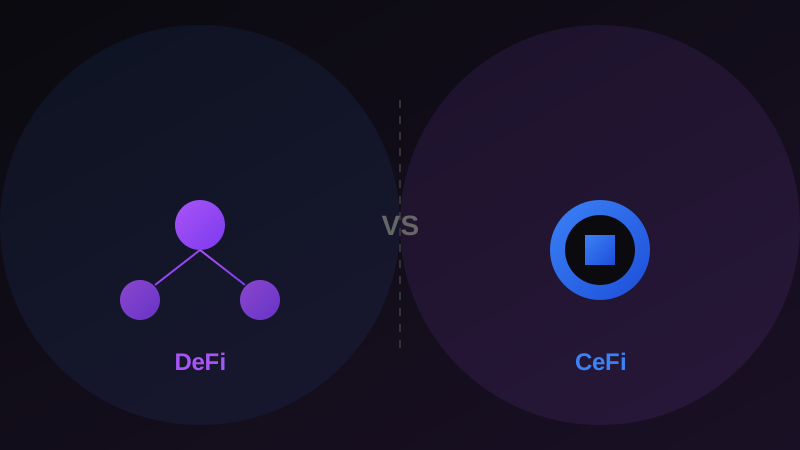
Centralized Finance (CeFi) refers to traditional crypto services operated by companies. Examples include Coinbase, Binance, and Kraken.
Decentralized Finance (DeFi) refers to financial services built on blockchain protocols without central intermediaries. Examples include Uniswap, Aave, and Compound.
Privacy in CeFi
How CeFi Handles Your Data
Centralized exchanges collect extensive personal information:
- Full legal name
- Government ID documents
- Facial recognition data
- Home address
- Financial information
- Transaction history
- IP addresses and device information
Privacy Risks in CeFi
Data Breaches: Centralized databases are attractive targets for hackers. Several major exchanges have experienced breaches exposing user data.
Government Requests: CeFi platforms must comply with law enforcement requests and may share your data with authorities.
Internal Access: Employees may have access to your personal information and transaction history.
Third-Party Sharing: Many exchanges share data with analytics companies, blockchain surveillance firms, and partners.
CeFi Privacy Advantages
- Regulated environment may provide some consumer protections
- Customer support for account recovery
- Insurance on some holdings
Privacy in DeFi
How DeFi Handles Your Data
DeFi protocols typically don't collect personal information:
- No identity verification required
- Interact directly with smart contracts
- Only your wallet address is recorded
- No centralized database of user information
Privacy Challenges in DeFi
Public Blockchain: All transactions are visible on public blockchains. Anyone can see your wallet's transaction history.
Wallet Linking: If your wallet address is ever linked to your identity, your entire transaction history becomes connected to you.
Front-Running: Pending transactions are visible in the mempool, allowing others to see your intended actions.
Analytics: Sophisticated blockchain analysis can often trace funds and identify patterns.
DeFi Privacy Advantages
- No KYC requirements
- No centralized data collection
- Direct control of your funds
- Permissionless access
- Resistant to censorship
Privacy Comparison
| Factor | CeFi | DeFi |
|---|---|---|
| KYC Required | Yes | No |
| Data Collection | Extensive | Minimal |
| Transaction Privacy | Private from public | Public on blockchain |
| Breach Risk | High | Low |
| Government Access | Easy | Difficult |
| Pseudonymity | None | Yes |
Best Practices for Each
Maximizing CeFi Privacy
- Use only reputable, security-focused exchanges
- Enable all available security features
- Withdraw funds to personal wallets
- Use unique emails for each exchange
- Minimize the data you provide
Maximizing DeFi Privacy
- Use fresh wallets for different activities
- Consider privacy-focused blockchains
- Use DEXs on privacy chains when available
- Don't link wallets to social media or ENS names
- Use bridges to break transaction trails
Hybrid Approaches
Many privacy-conscious users combine CeFi and DeFi:
- Acquire crypto through CeFi (if necessary)
- Withdraw to personal wallet
- Use mixing or privacy tools
- Interact with DeFi from fresh wallets
- Return to CeFi only when converting to fiat
The No-KYC Alternative
No-KYC exchanges like GhostSwap offer a middle ground:
- No identity verification
- Convenient swap service
- Wide cryptocurrency selection
- No public blockchain exposure of personal data
- Simple user experience
Conclusion
Neither CeFi nor DeFi is perfect for privacy:
- CeFi exposes your identity but keeps transactions somewhat private
- DeFi protects your identity but exposes transactions publicly
The best approach depends on your specific needs. For many users, no-KYC exchanges offer an optimal balance—providing the convenience of centralized services without the privacy trade-offs of KYC verification.
Your financial privacy is valuable. Consider your options carefully and choose the approach that best protects your personal information while meeting your trading needs.